
| Home | |
| The Land | |
| The Guides | |
| The Experience | |
| The Trips | |
| Trip Schedule | |
| Reservations | |
| Links | |
| Contact Us |
"There's an
indefinable energy
here, maybe
because it's so far
north, so close to
the magnetic pole.
You can almost
see the curvature
of the earth as
you look north.
You feel that
you're on the
top of the world."

—Carol Kasza
|
The Land |
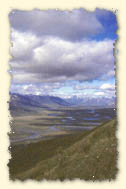
The Brooks Range is the living backbone of Alaska's
great Arctic wilderness. This northernmost extension of the Rocky Mountain
chain—stretching 600 miles long by 200 miles wide across the entire
Alaskan Arctic—is an untamed expanse so vast and complete you're
forced to redefine your whole notion of wildness—and yourself. The immensity
of it boggles the mind—a sweep of your eye from a high ridge can encompass
hundreds of miles untouched by human hands. To the north lies the phenomenal
openness of the coastal plain, while the Brooks Range itself rises into
layer upon layer of rugged mountains, split by enormous glacier-sculpted
valleys. On the south slope, extensive forests carpet the land and rivers
run free to the horizon.
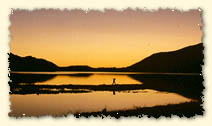
The
Light…
The vitality, the life energy of the Arctic summer
can't be contained in words. After a long, harsh winter, all life is
in high gear for the short, intense burst of summer. The sun never sets,
just dips lower on the horizon, creating late evening light of incredible
softness. All colors become exquisitely rich and deep, creating scenes
of such beauty they seem “other-dimensional.”
…The
Life
To those who look carefully, the land is always alive
with the signs of the the animals who live here. If the timing is right
and luck is with you, you can experience the “lifeblood” of
the Arctic—flowing rivers of caribou, following thousand year old migration
paths. Or you can be humbled as you ponder the palm-sized birds who
fly from the other end of the earth just to nest in this rich land.
The year-round residents of this arctic land are equally intriguing,
from grizzly bears, wolves, snowy owls, Dall sheep, wolverines and foxes,
to the most archetypal arctic animal, the musk ox, who still stand fierce
against a threat, their long “skirts” billowing in the wind,
unchanged since Pleistocene times.
Artwork: Ursula
Schneider
Site Management: Information Insights
©
Arctic Treks. All rights reserved.
Home | The
Land | The Guides |
The Experience | The
Trips | Contact Us